Affinity Beyond & Before – When does editing an image start?
This Friday, we are going to explore image editing, particularly using the FREE Affinity software.
But before we open the software, I want to ask a question: When does editing a photograph actually begin?
Is it when we sit down at our computers, or does it begin much earlier, perhaps even before we press the shutter?
To explore this, we will look at the work and methods of one of photography’s great masters, Ansel Adams.
Fifty years ago, when I was starting out as a press photographer, I found Adams inspirational. Newspaper reproduction was relatively poor in those days, and we photographers had to work hard to produce negatives of the highest possible quality.
Adams was a master of the photographic process, but what particularly fascinated me was his approach to making an image.
He didn’t simply take a photograph and then decide what to do with it. He would previsualise the finished print before exposing the negative.
He understood how exposure, film development and printing could work together to produce the image he had imagined.
He might deliberately overexpose or underexpose a negative, adjust development times, alter chemical dilutions or change agitation during processing to influence contrast and tonal values. Later, in the darkroom, he would use techniques such as dodging and burning to refine the final print.
In other words, editing wasn’t something he did after taking the photograph. It was part of the creative process from the very beginning.
I often wonder what Ansel Adams would make of digital photography today. I suspect he would be in his element with the extraordinary control we now have over our images.
But which software would he choose?
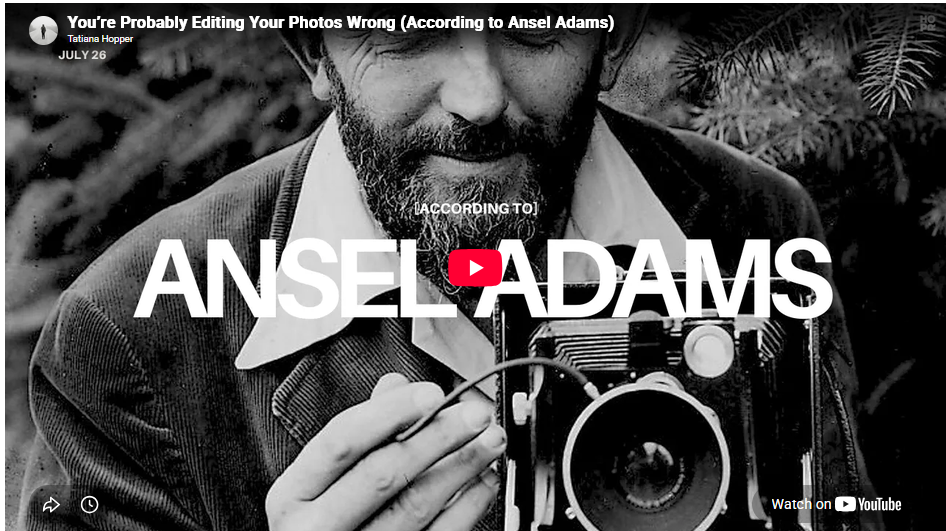
In her YouTube above photographer Tatiana Hopper refers to Luminar, a program I also use. It offers some powerful editing tools, although it comes at a cost.