Texture 1 – High-Speed Sync (HSS) Flash
Creative Camera – Week 27
Texture: Learning to Become a God of Light
Our Friday morning Creative Camera sessions continue with what might seem an unusual subject – texture. But this isn’t really a lesson about photographing rough bark, rusty metal or the fibres of a piece of paper. It is a lesson about something far more important: light.
This is the first session of our July Texture Project.
Many photographers believe they photograph subjects. In reality, photographers photograph light. The camera simply records the light reflected from the world around us. Once we understand that, everything changes.
During this practical morning we will use a single Godox flashgun with High-Speed Sync (HSS) (or whatever flash you have) to dramatically reduce the influence of the available light. By doing this, we place ourselves in complete control of how the photograph is lit. Instead of accepting whatever light nature provides, we create our own.
By moving the flash around the subject, even by just a few centimetres, we will see how texture suddenly appears or disappears. Side lighting reveals every wrinkle, grain, crack and fibre, while front lighting smooths and softens the same surface. It is a simple exercise, but one that changes the way photographers think.
More importantly, this session builds confidence. Once you discover that you can make something as ordinary as a toilet roll, a leaf or a piece of wood look dramatic simply by controlling the light, flash photography becomes far less intimidating. You stop worrying about the equipment and begin thinking creatively.
Although we are exploring texture, the principles we learn apply to almost every area of photography. Portraits, macro, still life, nature, product photography and even street photography all rely on understanding how light creates shape, form and atmosphere.
This is why we have chosen texture as the starting point for our Creative Camera programme. Before learning more advanced techniques, it is essential to understand that photography is not simply about recording what is in front of us. It is about making choices.
The camera records what is there.
The photographer decides what is important by choosing the light.
At AppFrod Camera Club we believe photography should be practical, creative and enjoyable. Every Friday morning is an opportunity to experiment, learn together and develop new ways of seeing. We hope this first session inspires you to look beyond the subject and begin to understand the power of light itself.
What is High-Speed Sync (HSS) Flash?
Before we begin, it is worth clearing up one common misunderstanding. High-Speed Sync (HSS) does not remove the ambient light. Instead, it allows us to use much faster shutter speeds, which reduce the exposure from the ambient light until the flash becomes the dominant light source. It is a subtle difference, but an important one. Photography is always a balance between available light and flash, and HSS gives us much greater control over that balance.
One of the techniques we will be using during our Creative Camera session is High-Speed Sync (HSS). Although it sounds complicated, the idea is actually quite simple and we will use it to make our subject and the texture of the subject jump off the page.

As a quick demonstration I snapped this image of the stapler on my desk. The room is full of available light with big windows that gets the sun all day.
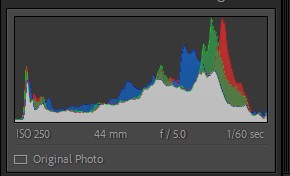
I wanted to blur the background, and using 44mm on my full frame sensor camera at f5 it worked ok, but I felt the background was too complicated and I wanted the stapler to look ‘sexier’!
Normally, a camera can only use flash up to a certain shutter speed, known as the flash sync speed. On many cameras this is around 1/200 or 1/250 second. If you use a faster shutter speed with ordinary flash, part of the image will be hidden by the camera’s shutter, leaving an ugly black band across the photograph.
High-Speed Sync overcomes this limitation.
Instead of producing one quick burst of light, the flash fires a rapid series of tiny pulses as the shutter travels across the sensor. This allows the flash to work at shutter speeds such as 1/1000, 1/2000 or even 1/8000 second.
But why is that useful?
The faster the shutter speed, the less ambient light reaches the camera’s sensor. In bright sunshine, for example, increasing the shutter speed darkens the natural light in the scene while the flash continues to illuminate your subject.
This gives you something very powerful – control.
Rather than allowing daylight or room lighting to dictate how your photograph looks, you decide exactly how much influence the available light has. You can make the background darker, reduce unwanted distractions, or create dramatic side lighting that reveals texture and shape.
During our texture exercise we will use HSS to reduce the exposure from the available light until the flash becomes the main light source. Once we have achieved that, every movement of the flash changes the appearance of the subject. Move it to the side and the texture becomes bold and dramatic. Bring it towards the front and the surface becomes smoother and softer.
This is why High-Speed Sync is such an important creative tool. It is not simply a way of using faster shutter speeds. It is a way of taking control of the light.
Photography is often described as “painting with light.” High-Speed Sync gives us a much finer brush.
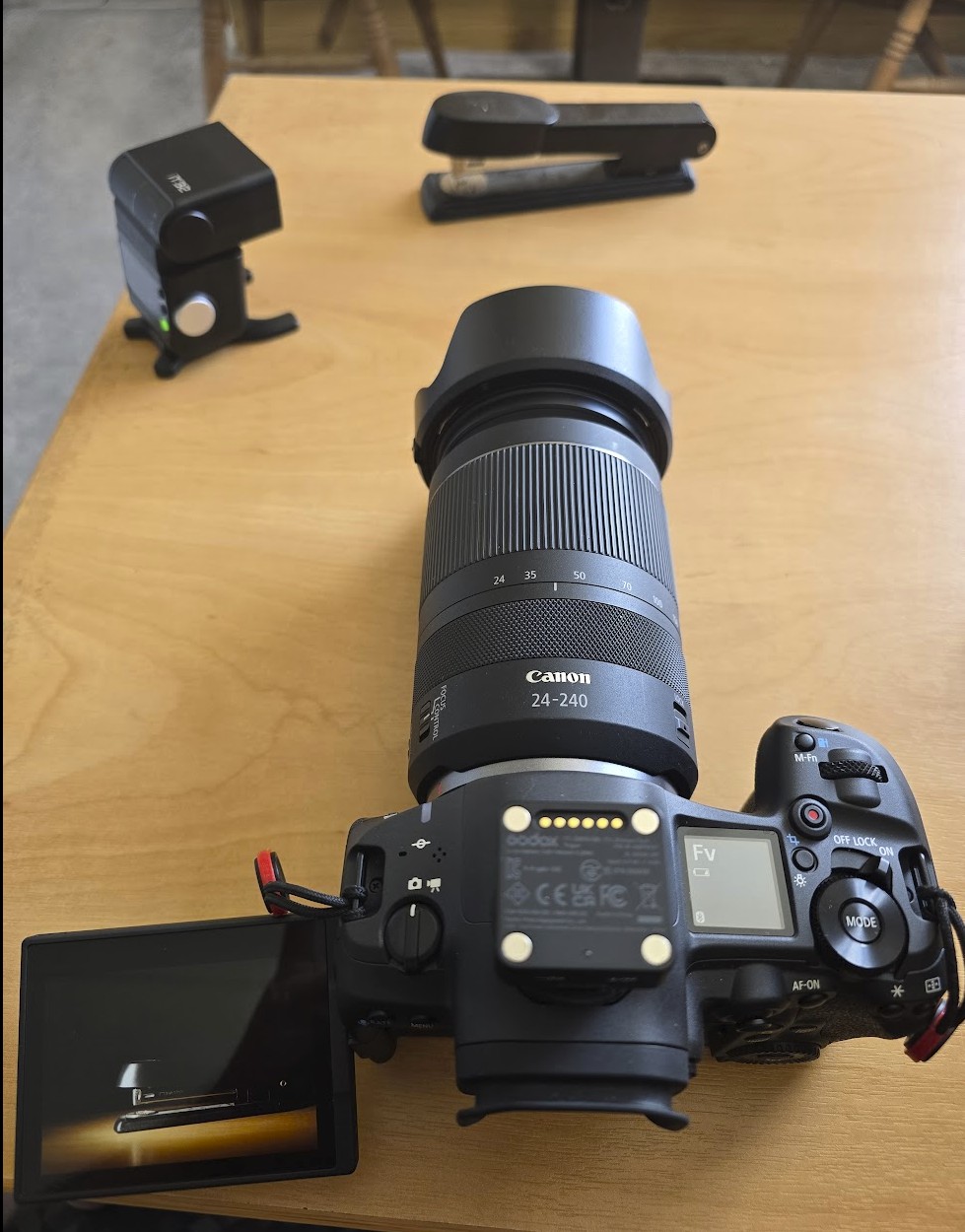
This is the very (VERY) simple set up I used to make the stapler appear ‘sexy’. This is the resulting image –

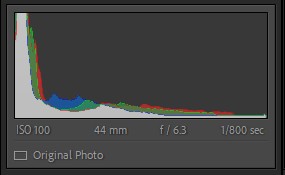
– and these were my shutter-speed and aperture settings. You can also see how the histogram has changed compared to earlier settings image
Hand-outs