Landscape – Our Theme for August at AppFrod Camera Club
Our Monthly Competition for August is Landscape and Natural History (Deadline is 21st August 2026)
Often, when we think of landscape or natural history, we think of a scenic view or a photograph of an animal, bird or plant. Mountains glowing at sunrise, a dramatic coastline, a kingfisher in flight or a colourful wildflower are all wonderful subjects, and there is nothing wrong with photographing them.
But photography can offer us much more.
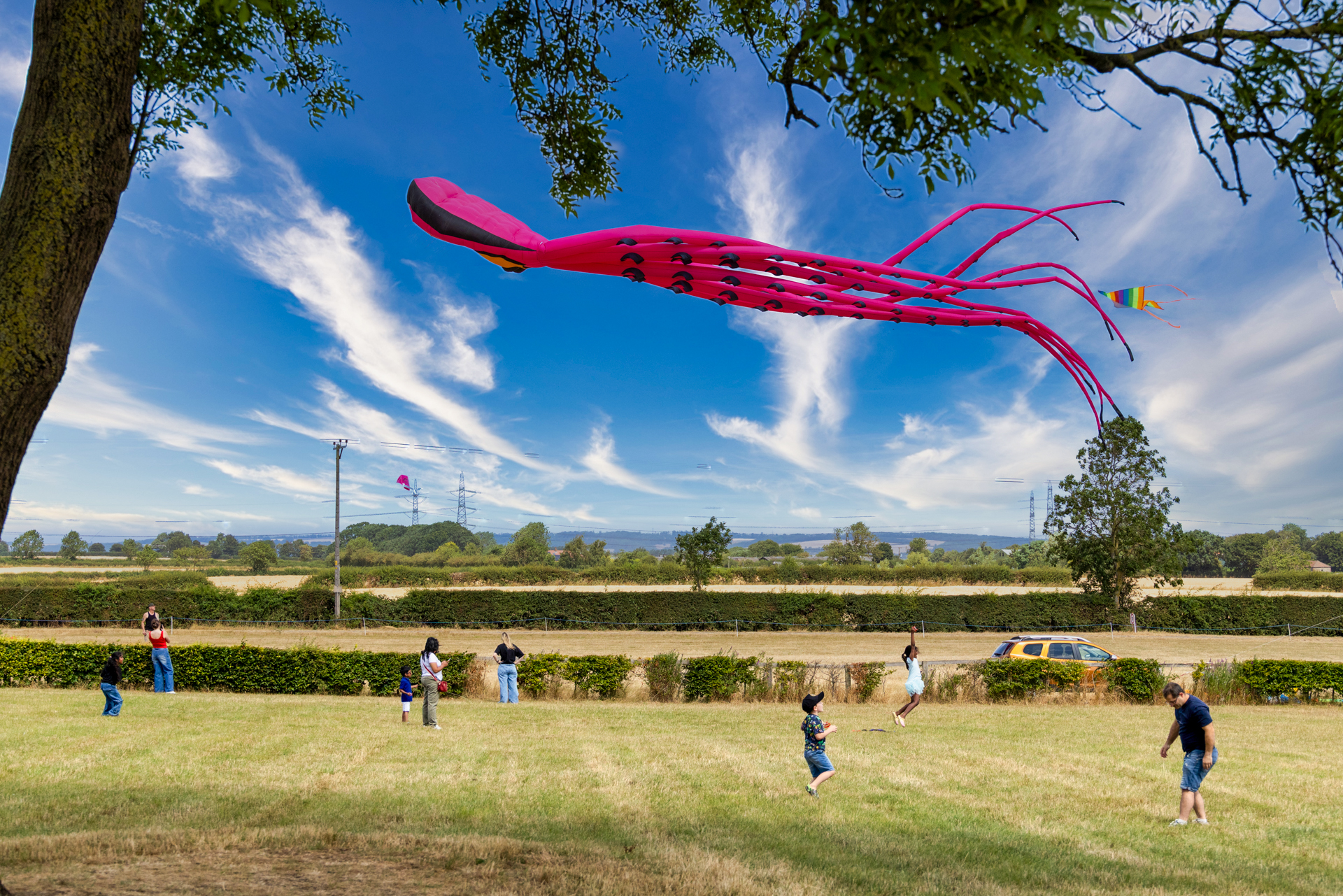
But, landscape and natural history photography can be much more than simply recording attractive subjects. Instead, we can use our cameras to explore, and understand the stories that exist all around us. Landscape and natural history are not simply genres of photography; they are two different ways of understanding the world. One explores place, the other explores life, and together they reveal the relationship between people, nature, history and time.
Photography can help us understand more about what we see because it encourages us to look beyond appearance. It invites us to explore how people, place, light and memory come together to create the essence of a landscape.
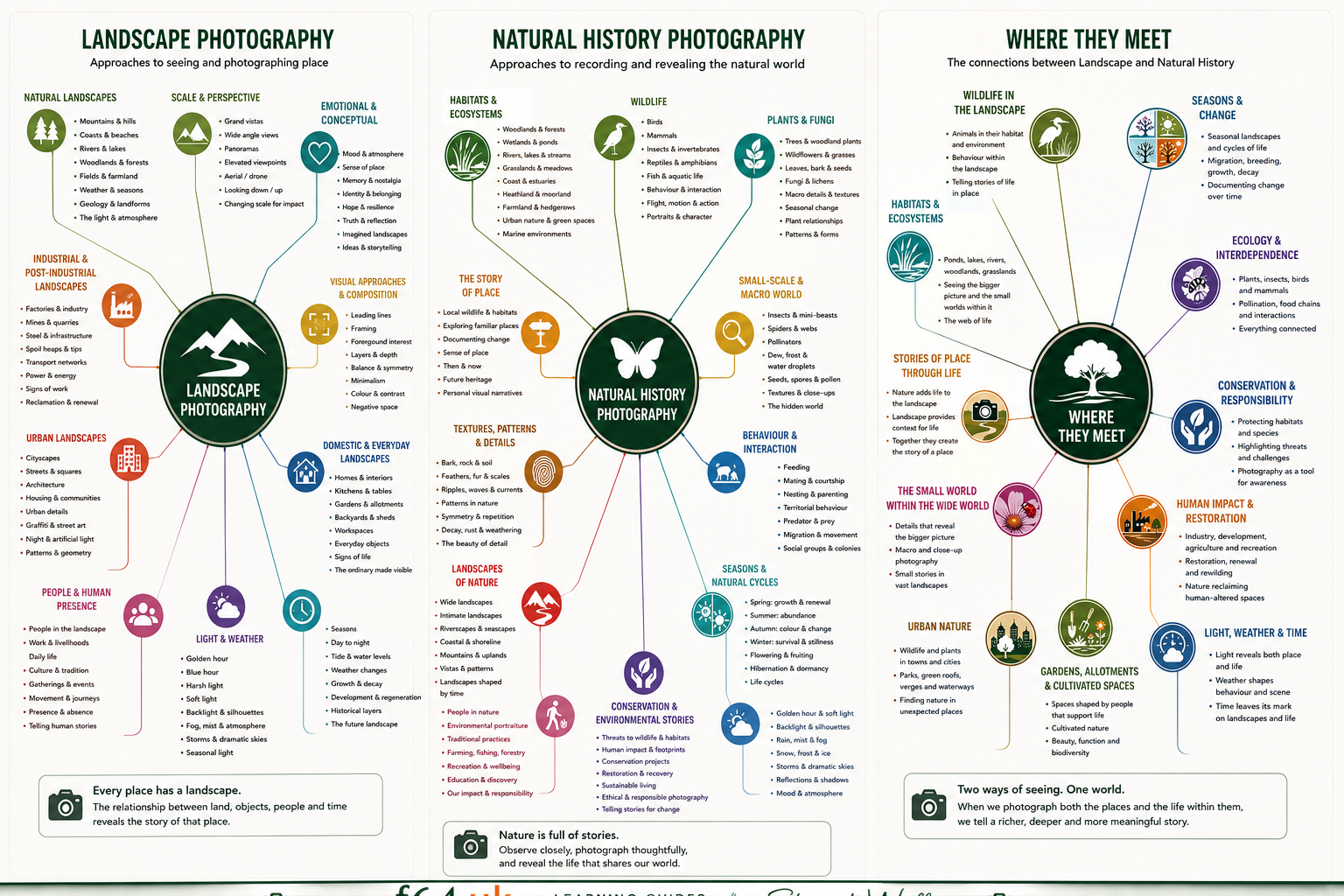
I’ve created three learning guides to accompany this month’s theme. They aren’t checklists of subjects to photograph but maps of ideas designed to encourage you to look differently at the world around you. I hope they inspire you to experiment, become more curious and perhaps discover subjects you might previously have walked straight past.
Every Place Has a Landscape
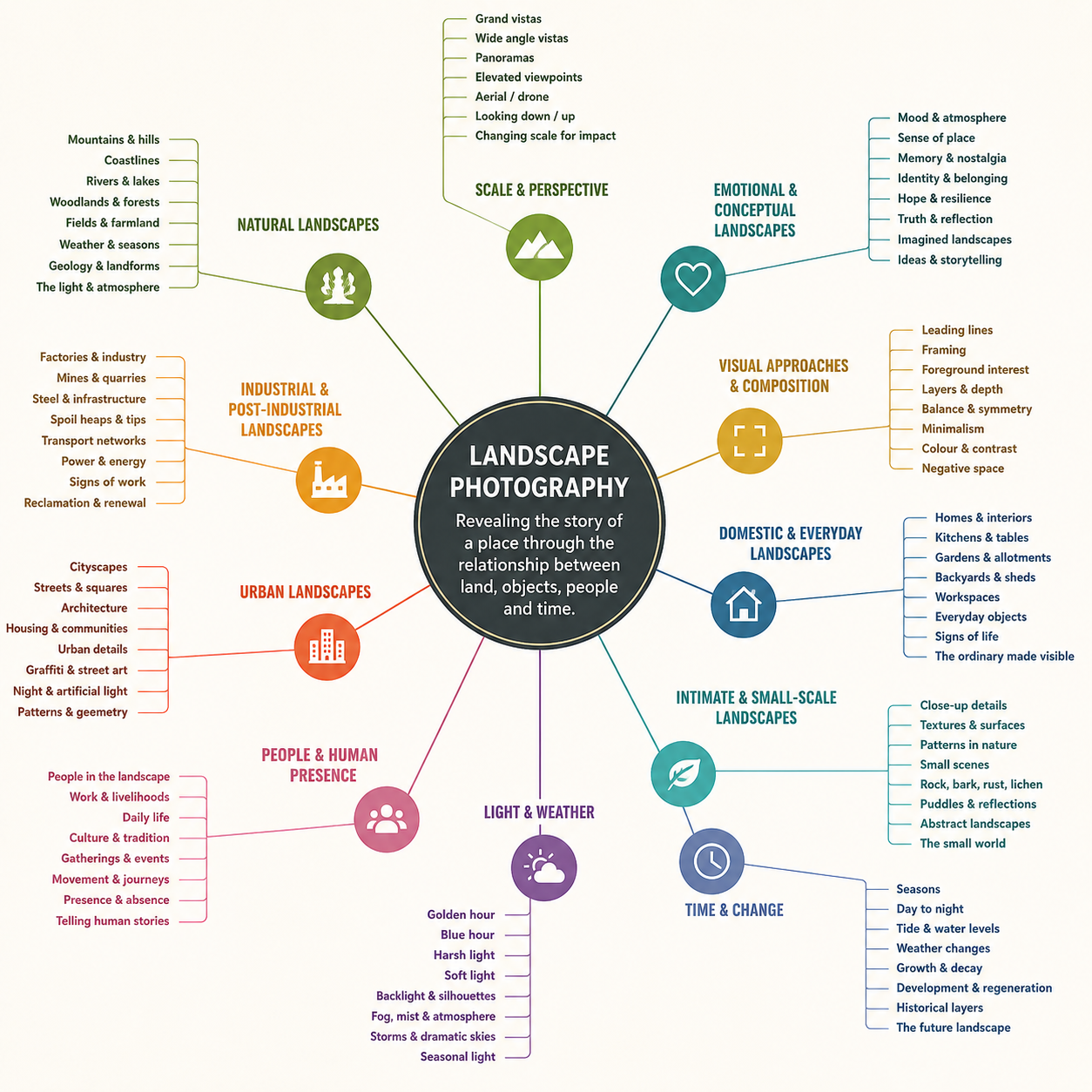
Landscape photography has traditionally been associated with spectacular scenery. Mountains, waterfalls, forests and coastlines have dominated calendars, greetings cards and coffee-table books for decades.
Yet landscape is not defined by hills, mountains or dramatic scenery.
A landscape is any place where the relationship between land, objects, people and time reveals the story of that place.
That means every place has a landscape.
A city street.
A church.
An allotment.
A football ground.
A steelworks.
A woodland.
Even your own kitchen.
The size of the subject doesn’t matter. What matters is understanding how different elements work together to create a sense of place. Landscape photography becomes less about finding beautiful scenery and more about discovering the character of the places we encounter every day.
Sometimes the most interesting landscapes are those we pass without noticing.
Natural History Can Be More Than Wildlife

Natural history photography is often thought of as photographing birds, mammals, butterflies or flowers.
Again, these are wonderful subjects, but natural history is really about understanding the living world.
It asks questions.
How does this species survive?
Why does this habitat exist here?
What relationships exist between insects, plants, birds and mammals?
How do the seasons transform the same place?
How does nature adapt to urban environments?
Natural history photography encourages patience, observation and curiosity. It reminds us that every living thing is part of a much larger story.
Where Landscape and Natural History Meet
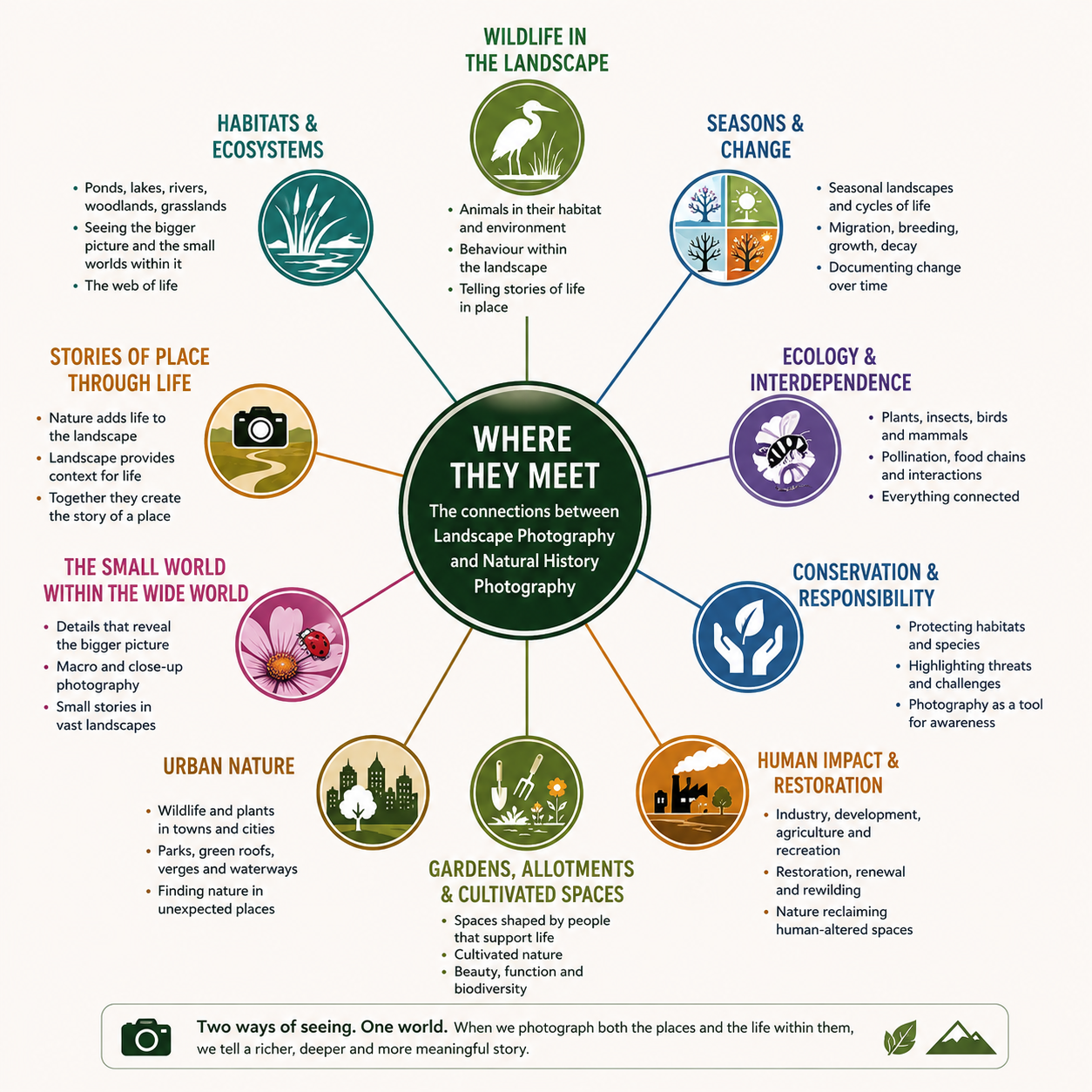
Landscape and natural history are often treated as separate photographic genres, yet in reality they overlap constantly.
A landscape without life can sometimes feel empty.
A wildlife photograph without its environment often loses part of its story.
When we include both together, our photographs become richer.
A heron standing on the edge of a flooded quarry says something about habitat.
Wildflowers growing beside an abandoned railway tell a story of nature reclaiming industry.
A butterfly resting on an allotment flower speaks of the relationship between people and wildlife.
Reeds growing around Silica Ponds remind us that nature has transformed a landscape once shaped by extraction and industry.
These are not simply photographs of places or photographs of wildlife.
They are photographs about relationships.
Photography begins long before pressing the shutter.
It begins by learning to notice.
Ask yourself:
- Why does this place look like this?
- What happened here before?
- Who uses this place?
- What lives here?
- What has changed?
- What might this place become in fifty years?
These questions often lead to stronger photographs because they encourage us to think about meaning rather than appearance.
The camera records what is in front of us. The photographer decides what is important. Learning to see is perhaps the greatest skill we can develop, and it comes through curiosity rather than expensive equipment.
Looking Beyond the Obvious
During August I’d encourage you to challenge yourself.
Don’t only photograph the obvious view.
Look for the intimate landscape.
Photograph texture revealed by light.
Explore reflections.
Notice patterns created by plants.
Watch how weather changes familiar places.
Look for evidence of time, history and human activity.
Observe the interaction between wildlife and its surroundings.
Try making photographs that explain a place rather than simply recording it.
Don’t worry if your photographs aren’t immediately dramatic. Some of the most rewarding images are quiet observations that reveal something others might easily overlook.
Bringing July into August
Last month we explored texture, discovering that texture isn’t something we photograph—it is something that light reveals.
That lesson remains just as important this month.
Whether you’re photographing a sweeping landscape, the bark of an ancient tree, ripples across a pond, rust on an old gate or the delicate veins of a leaf, it is the quality and direction of light that reveals form, depth and atmosphere.
As you head out with your camera, don’t just ask yourself:
“What am I photographing?”
Ask instead:
“What is the light revealing?”
Sometimes the difference between an ordinary record shot and a memorable photograph is not the subject itself, but the way light uncovers its character.
A Month of Discovery
My hope is that this month’s theme will encourage every member to become more curious about the world around them.
You don’t need dramatic scenery or rare wildlife to make meaningful photographs.
You simply need to look carefully, ask questions and remain open to discovery.
Whether you’re walking through a country park, exploring your own garden, wandering around town or sitting beside a pond, remember that photography is about much more than recording what we see.
It is about revealing the stories that already exist.
Because every place has a landscape.
Every landscape contains life.
And every photograph has the potential to tell a story.
So this August, don’t just go looking for photographs. Go looking for relationships. Because it is in the relationship between place, life, light and time that the most meaningful photographs are often found.



One Comment