Sense of Place
How the Ascoughs create a sense of place in their Landscape Photography
‘Seeing’ A Sense of Place
Learning to Look: From Observation to Photographic Storytelling
Module 2 – Foundations: The Secret of Creating a Great Photobook
How do we move from photographing something to making photographs about something?
I want to share an experience from my early training as a photojournalist, nearly fifty years ago, and show you how I still apply that lesson to my photography today.
1. Encounter — Learning to Observe
When I was studying photojournalism, one of our tutors gave us an assignment that seemed rather strange at the time.
We were instructed to visit the same scene for five consecutive days. Each day, we had to study it carefully and write down ten things we had not noticed on any of our previous visits.
Ten new observations every day. Fifty altogether.
It sounds simple, doesn’t it?
On the first day, finding ten things was relatively straightforward. We noticed the obvious features: the buildings, the people, the signs and the activities taking place.
But as the days progressed, the assignment became increasingly difficult.
We had already recorded the obvious things. Now we had to look more carefully.
We began noticing smaller details, relationships between objects, the way people interacted with their surroundings and things happening in the background.
We started asking questions about what we were seeing.
Why was something there? What was happening? How did one thing relate to another?
The exercise taught me something that has remained with me throughout my photographic career.
Looking and seeing are not necessarily the same thing.
We can walk through a familiar place every day without really observing it. We recognise the buildings and streets, but often overlook the stories unfolding around us.
As photographers, we need to develop the ability to look beyond the obvious.
We need to become curious.
And sometimes, the most interesting photographs emerge not from what first catches our attention, but from what we discover when we continue looking.
2. Respond — Discovering Connections
Yesterday, I was in Chesterfield with a group of photographers, exploring the town and looking for stories to tell through our cameras. The day was organised by John Rutherford, who visited AppFrod a few months ago. He has offered to host other days for us in the Chesterfield area.
Chesterfield is famous for the extraordinary crooked spire of St Mary and All Saints Church.
There is a wonderful piece of local folklore surrounding it.
According to one version of the legend, the Devil was sitting on the church spire with his tail wrapped around it. When he discovered that a virgin was getting married in the church, he was so surprised that he flew away, forgetting to unwrap his tail, and twisted the spire.
Another version suggests that the spire itself was so astonished to see a virgin bride that it twisted around to take a closer look.
And the local joke continues that the spire will only straighten when another virgin marries there!
The real explanation is rather more architectural, involving the timber construction and lead covering, but the folklore is much more entertaining.
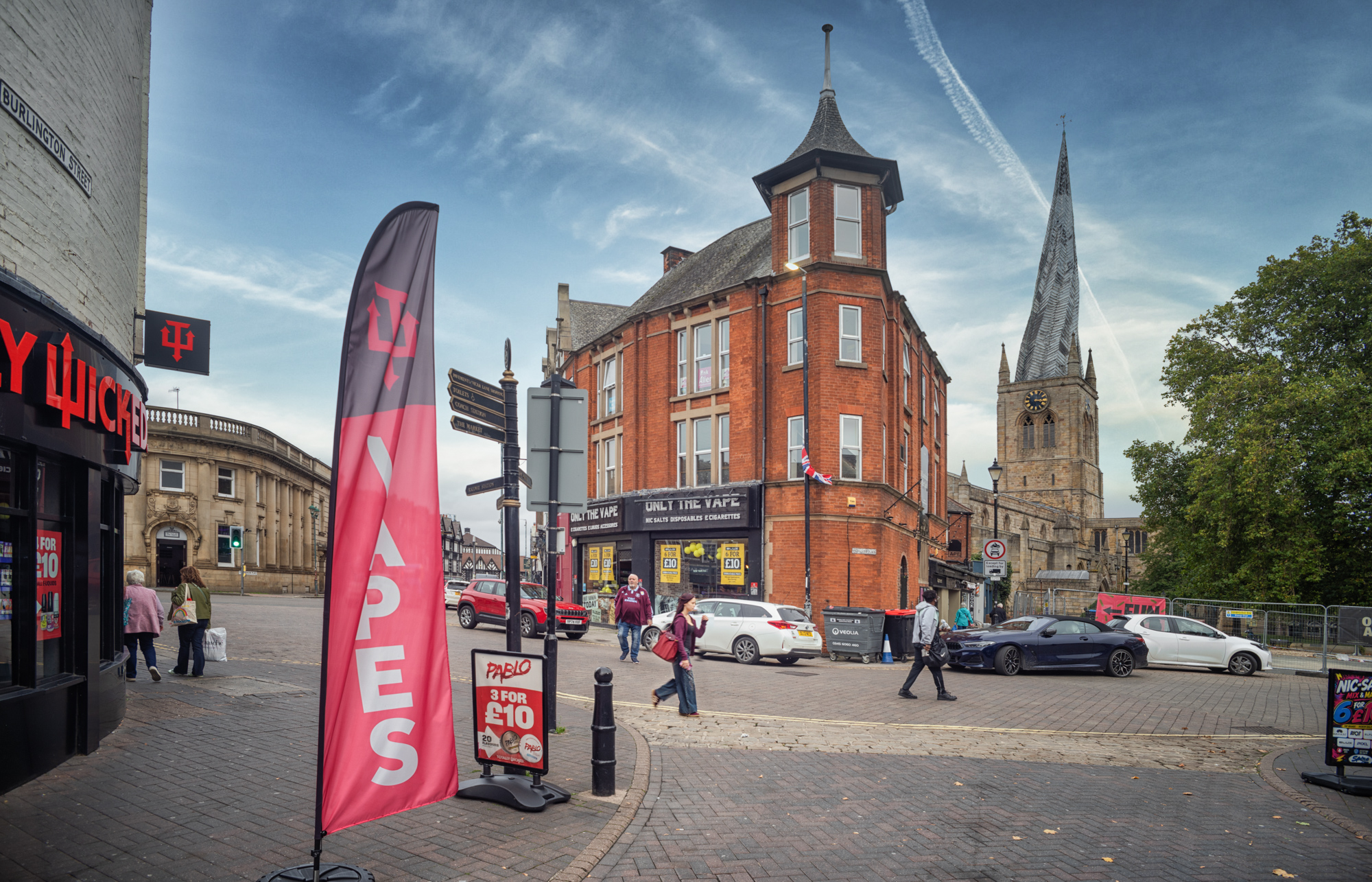
As I walked towards the church, I noticed a vape shop called Totally Wicked.
Its red logo immediately reminded me of the Devil’s pitchfork.
That caught my attention.
But instead of simply photographing the sign, I continued looking.
There was an enormous pink flag advertising vapes. Another shop stood across the road, also selling vaping products.
Then I noticed the prices.
One advertisement offered three Pablo products for £10. Across the road, another offered six vapes for £10.
I began thinking about temptation, competition, consumerism and the Devil.
And rising above it all was the crooked spire, with its centuries-old stories about the Devil and the virgins of Chesterfield.
Suddenly, the individual elements began to connect.
I wasn’t simply looking at a street corner any more. I was discovering a story.
This was that journalism college exercise in action, nearly fifty years later.
The important point is that I didn’t arrive in Chesterfield intending to make a photograph about temptation and religion.
The idea emerged because I was observing, recognising connections and responding to what I discovered.
3. Shape — Composing with Intention
Having recognised those connections, I now needed to consider how I could communicate them through a photograph.
This is where observation becomes cameracraft.
I wasn’t simply going to point my camera at the crooked spire and press the shutter.
I wanted to bring several elements together within a single frame so that they might suggest a relationship to the viewer.
I positioned myself so that the Totally Wicked shop and its devil-like symbol appeared on the left of the composition.
The enormous pink VAPES flag dominated the foreground, immediately drawing attention to the contemporary commercial activity.
Beyond it were the competing vape advertisements, including the offers of three for £10 and six for £10.
And rising above everything was the church with its crooked spire.
The people walking through the scene provided another important element.
They were simply going about their everyday lives, apparently oblivious to the connections I was making between the shops, their advertising and the church.
I wanted all these elements to coexist within the photograph.
The positioning of the camera, the viewpoint, the arrangement of the buildings and the inclusion of the foreground flag were deliberate decisions.
Each element had a purpose.
I was using composition to connect things that might otherwise have gone unnoticed.
This is an important distinction.
Composition is not simply about making a photograph look attractive or following rules such as the rule of thirds.
Composition can be used to communicate ideas.
By deciding what to include, what to exclude and how the elements relate to one another, we begin to shape the meaning of our photographs.
Had I moved a few metres, excluded the shop sign or photographed only the spire, I would have created a very different image.
The subject might have remained Chesterfield, but the story would have changed.
And that is something I would like you to consider when making photographs for your own projects.
What are you trying to communicate, and how can your cameracraft help you communicate it?
4. Reflect — Developing a Photographic Narrative
When I returned to look at the photograph, I began thinking about what I had actually created.
Was it simply a photograph of a street in Chesterfield?
Or was it a photograph about something?
For me, it had become an exploration of temptation, commerce, folklore, religion and the relationship between a town’s history and its contemporary life.
But there is an important consideration.
Not everyone looking at the photograph will know the legend of the crooked spire.
Some viewers might notice the vape shops and their advertisements. Others might be interested in the architecture or the people.
Some might recognise the devil-like symbol but make no connection with the church.
And that is perfectly fine.
A photograph can communicate different things to different people.
However, when we begin creating photo-essays, projects and photobooks, we have an opportunity to develop those ideas further.
Imagine that this photograph became the starting point for a short photographic essay about Chesterfield.
What other photographs might I need?
Perhaps I could photograph the crooked spire in greater detail.
I might look for other examples of the town’s folklore appearing alongside contemporary life.
I could explore the relationship between the historic church and the commercial streets surrounding it.
I might photograph the people who inhabit those spaces, the signs they walk past every day and the small details that reveal something about the character of the town.
Each photograph could contribute another piece of information.
And through editing and sequencing, I could begin to build a narrative.
Text could also play an important role.
Without knowing the legend, the viewer might not recognise the connection between the Devil and the crooked spire.
A short passage of writing could introduce that folklore and encourage the reader to return to the photograph with a different understanding.
This is one of the great strengths of the photobook.
The photographs, their sequence and the accompanying text can work together to communicate something that an individual photograph might not achieve on its own.
Of course, I would need to decide whether there was enough substance in the idea to sustain an entire photobook.
One interesting photograph does not necessarily make a photographic project.
But it might provide the question that starts one.
And that brings me back to something I have been encouraging you to think about throughout this course.
Are you photographing something, or are you photographing about something?
Had I simply photographed the church, I would have made a photograph of Chesterfield’s crooked spire.
Instead, I was attempting to make a photograph about the relationships I had discovered around it.
That distinction is fundamental to developing meaningful photographic projects.
Bringing It All Together
The four stages we have explored are:
- Encounter: Observe the world around you. Look carefully and remain curious.
- Respond: Recognise what interests you. Discover relationships and begin asking questions.
- Shape: Use your cameracraft, composition and visual decisions to communicate your ideas.
- Reflect: Consider what your photographs mean, what they communicate and how they might develop into a wider narrative.
These stages are not necessarily separate or linear. We often move between them as our understanding of a subject develops.
And sometimes we return to the same place, make new observations and discover that our original ideas have changed.
That is part of the creative process.
Nearly fifty years ago, my journalism tutor taught me to look.
Today, I am still using that lesson every time I pick up my camera.
Don’t simply photograph what you see. Learn to see what you might photograph.
And always ask yourself:
Why Did I Stop?